If you have sensitive skin, choosing a hair-removal method can feel surprisingly complicated.
You want smooth skin and well-shaped brows, but you also don’t want unnecessary redness, irritation or discomfort afterward.
Two of the most popular options for facial hair removal are threading and waxing.
Both can be effective. However, they work differently, and the better choice can depend on the area being treated, your skin sensitivity, your skincare routine and your personal preferences.
So, is threading better than waxing for sensitive skin?
Not necessarily for everyone.
Threading may be a good option for people who want precise facial hair removal without applying wax to the skin. Waxing, on the other hand, can be quick and effective for removing multiple hairs at once.
In this guide, we’ll compare threading vs waxing for sensitive skin, explain the main differences and help you decide which option may be more suitable for your next appointment in Mandurah.
Quick answer: Threading can be a suitable option for some people with sensitive facial skin because it removes individual hairs without applying wax to the skin. However, both threading and waxing can cause temporary redness or irritation, so your skin condition and individual circumstances should be considered before treatment.
What Is Threading?
Threading is a traditional hair-removal technique that uses a thin cotton or similar thread.
The thread is twisted and rolled across the skin to capture individual hairs and remove them from the follicle.
It is particularly popular for:
- Eyebrows
- Upper lip
- Chin
- Sideburn areas
- Facial hair
One of the biggest advantages of threading is precision.
A trained professional can remove individual hairs and shape the eyebrows carefully.
This makes threading especially popular for brow shaping.
What Is Waxing?
Waxing uses a layer of wax to grip unwanted hair before it is removed.
Depending on the treatment, waxing can be used on areas such as:
- Eyebrows
- Upper lip
- Chin
- Arms
- Legs
- Underarms
- Other body areas
Waxing can remove multiple hairs at once, which makes it an efficient option for larger areas.
However, because wax comes into contact with the skin, people with sensitive or easily irritated skin need to take extra care.
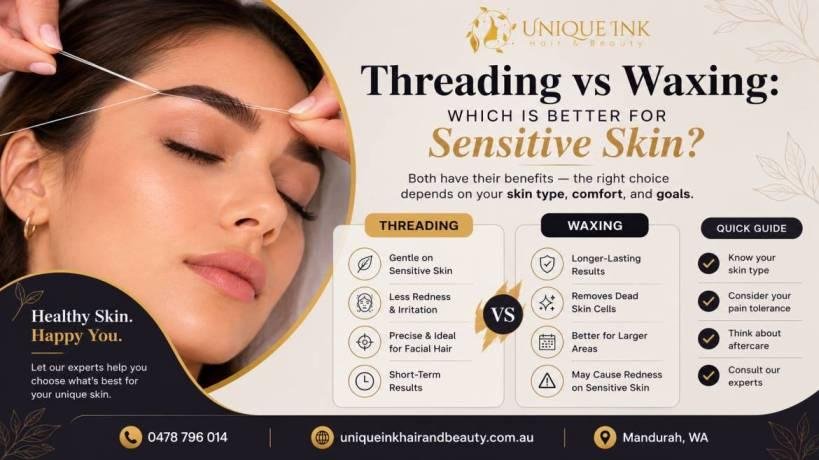
Threading vs Waxing: At a Glance
| Factor | Threading | Waxing |
| Hair removal | Individual hairs | Multiple hairs at once |
| Precision | Excellent | Good |
| Suitable for brows | Very suitable | Very suitable |
| Larger areas | Less practical | Efficient |
| Wax contact | No | Yes |
| Temporary redness | Possible | Possible |
| Skin sensitivity | Can suit some sensitive skin | May irritate some sensitive skin |
| Speed | Quick for small areas | Very quick for larger areas |
| Best known for | Precision and brow shaping | Efficient hair removal |
Neither method is automatically the right choice for everyone.
Is Threading Better for Sensitive Skin?
Threading can be a useful choice for some people with sensitive skin because the technique does not involve spreading wax across the skin.
Instead, the thread primarily interacts with the hairs being removed.
This can be particularly appealing when you’re having your eyebrows shaped.
However, threading can still cause temporary:
- Redness
- Sensitivity
- Mild irritation
- Small bumps in some people
Your skin may look slightly red immediately after the treatment, especially if you’re new to threading.
That usually isn’t a reason to panic, but you should follow your professional’s aftercare advice.
Is Waxing Suitable for Sensitive Skin?
Waxing can be suitable for some people with sensitive skin, but additional caution may be necessary.
The main issue is that waxing doesn’t only interact with the hair.
Wax is applied directly to the skin.
When it is removed, the action can temporarily affect the uppermost layer of skin as well as removing hair.
This may result in temporary redness or sensitivity.
For most people, this is manageable.
But if your skin is particularly reactive, you should tell your beauty professional before treatment.
Threading vs Waxing for Eyebrows
For eyebrows, threading has one major advantage:
Precision.
Because threading allows individual hairs to be removed, your beauty professional can carefully shape the brow.
This can be particularly useful when you want:
- Defined brows
- Natural-looking shaping
- Precise cleanup
- Control over individual hairs
Waxing can also produce beautifully shaped eyebrows and is often quick.
The choice often comes down to personal preference and how your skin responds.
Threading vs Waxing for the Upper Lip
Both methods can be used for upper-lip hair removal.
Threading
Threading allows the professional to target individual hairs and does not involve applying wax to the facial skin.
Waxing
Waxing can remove several hairs quickly.
However, if you have very sensitive skin or use skincare products that increase skin sensitivity, discuss this with your professional before choosing waxing.
Which Method Hurts More?
This is another question without a universal answer.
Pain and discomfort vary significantly between individuals.
Threading
You may feel a repeated pulling or pinching sensation as hairs are removed.
Waxing
You may experience a quick pulling sensation when the wax is removed.
The experience can also depend on:
- Hair thickness
- Treatment area
- Individual sensitivity
- Previous hair-removal experience
- Technique used by the professional
Some people prefer threading, while others find waxing more comfortable.
Can Threading Cause Irritation?
Yes.
Although threading doesn’t use wax, it doesn’t mean the skin cannot react.
Temporary redness can occur after threading.
You may be more likely to notice irritation if:
- Your skin is already irritated
- You have recently exfoliated
- You’re experiencing a skin flare-up
- You repeatedly touch the treated area
- You use irritating products immediately afterward
This is why proper aftercare matters.
Can Waxing Cause Irritation?
Yes.
Waxing can cause temporary:
- Redness
- Sensitivity
- Small bumps
- Skin discomfort
In some cases, improper waxing technique can cause more significant irritation.
That’s one reason professional waxing is preferable to attempting complicated facial waxing yourself.
Important: Your Skincare Routine Matters
If you have sensitive skin, your skincare routine is particularly important when deciding whether to wax.
Tell your beauty professional if you’re using products that can increase skin sensitivity.
For example, some active skincare ingredients and medications can make waxing unsuitable or increase the risk of skin irritation.
Don’t assume that a facial wax is automatically safe just because you’ve waxed before.
Your skin can change over time.
When in doubt, disclose your current skincare products and ask your professional whether waxing is appropriate.
Threading vs Waxing Aftercare
Whichever method you choose, your skin may be more sensitive immediately afterward.
After Threading
You may be advised to:
- Avoid touching the treated area unnecessarily
- Avoid irritating skincare products immediately afterward
- Keep the area clean
- Follow your professional’s instructions
- Protect your skin from excessive sun exposure
After Waxing
Similar precautions may apply.
You may also be advised to avoid:
- Excessive heat
- Heavy sweating immediately after treatment
- Harsh exfoliation
- Fragranced products on freshly waxed areas
Always follow the specific aftercare advice provided by your beauty professional.
What Should You Avoid Before Threading or Waxing?
If your skin is sensitive, preparation can make a difference.
Before threading:
- Avoid unnecessary exfoliation.
- Don’t pick at the skin.
- Tell your professional about irritation.
- Mention recent facial treatments.
Before waxing:
- Tell your professional about your skincare routine.
- Mention any products or medications that may increase skin sensitivity.
- Don’t wax over irritated or damaged skin.
- Avoid experimenting with new skincare products immediately beforehand.
A professional can decide whether the treatment should go ahead.
Threading vs Waxing: Which Is Better for Your Eyebrows?
If your priority is precision, threading may have an advantage.
It allows individual hairs to be targeted, which can be useful when creating a particular brow shape.
If your priority is speed, waxing can be an efficient option.
However, the best choice depends on your:
- Skin sensitivity
- Brow goals
- Hair growth
- Previous experience
- Personal preference
Threading vs Waxing: Pros and Cons
Threading Pros
- Precise hair removal
- Excellent for eyebrow shaping
- No wax applied to the skin
- Suitable for small facial areas
- Individual hairs can be targeted
Threading Cons
- Can cause temporary redness
- May feel uncomfortable
- Less practical for large body areas
- Requires a skilled professional for precise results
Waxing Pros
- Fast hair removal
- Removes multiple hairs at once
- Suitable for facial and body areas
- Can create clean, smooth results
Waxing Cons
- Can cause temporary redness
- May irritate sensitive skin
- Wax contacts the skin
- Not suitable for everyone using certain skincare products or medications
When Should You Choose Threading?
Threading may be worth considering if:
- You’re shaping your eyebrows.
- You want precise hair removal.
- You’re removing hair from a small facial area.
- You prefer not to have wax applied to your skin.
- You’ve previously had good results with threading.
When Should You Choose Waxing?
Waxing may be more practical if:
- You’re treating a larger area.
- You want quick hair removal.
- You’ve previously tolerated waxing well.
- Your skin professional confirms it’s appropriate.
Common Mistakes With Sensitive Skin
Mistake 1: Waxing Without Mentioning Your Skincare Products
Always tell your professional about relevant skincare products.
Mistake 2: Exfoliating Immediately Before Treatment
This may increase sensitivity.
Mistake 3: Choosing Based Only on Price
Professional technique and hygiene matter.
Mistake 4: Touching the Skin After Treatment
Freshly treated skin can be more sensitive.
Mistake 5: Applying Strong Products Immediately Afterwards
Give your skin time to settle and follow professional aftercare instructions.
Mistake 6: Ignoring Persistent Reactions
If you experience an unusual or persistent reaction, seek appropriate medical advice.
Which Is Better Overall: Threading or Waxing?
There isn’t a single winner.
Choose threading if:
Precision + small facial areas + avoiding wax contact are your priorities.
Choose waxing if:
Speed + efficient hair removal + larger areas are more important.
For sensitive skin:
Threading may be preferable for some people, particularly for facial hair and brows, but it isn’t automatically irritation-free.
The best method is the one that suits your skin, treatment area and individual circumstances.
Why Choose Unique Ink Hair & Beauty for Threading and Waxing in Mandurah?
At Unique Ink Hair & Beauty, clients can access professional threading and waxing services in Mandurah alongside a range of other beauty treatments.
Located at 2/93 Pinjarra Road, Mandurah WA 6210, the salon provides beauty services including:
- Threading
- Waxing
- Brow and lash tinting
- Facials
- Cosmetic tattooing
- Fine Line Tattoos
- Microneedling
- Hair and makeup
If you’re unsure whether threading or waxing is more suitable for your skin, discuss your concerns before treatment.
A professional can consider the area you’re treating, your skin condition and your preferences before recommending an appropriate approach.
Frequently Asked Questions
1. Is threading better than waxing for sensitive skin?
Threading may suit some people with sensitive skin because it doesn’t involve applying wax to the skin. However, threading can still cause temporary redness or irritation.
2. Which is better for eyebrows, threading or waxing?
Both can work well. Threading offers excellent precision, while waxing can provide quick and clean hair removal.
3. Does threading hurt more than waxing?
There is no universal answer. Some people prefer the sensation of threading, while others find waxing more comfortable.
4. Can sensitive skin be waxed?
Some people with sensitive skin can wax safely, but additional precautions may be needed. Tell your professional about your skin and skincare routine first.
5. Does threading cause redness?
Temporary redness can occur after threading, particularly on sensitive skin.
6. How long does eyebrow threading last?
Results vary according to individual hair-growth cycles. Threading removes the hair from the root, so results generally last longer than simply trimming or shaving.
7. Can I wax while using active skincare products?
Some skincare products and medications can increase skin sensitivity and may make waxing unsuitable. Always disclose your current products and medications to your professional.
8. Should I exfoliate before threading or waxing?
Generally, avoid unnecessary exfoliation immediately before treatment. Your professional can advise you based on your skin.
9. Which is better for upper-lip hair, threading or waxing?
Both can work. Threading offers precise hair removal, while waxing can remove multiple hairs quickly. Sensitive skin may influence your choice.
10. Where can I get threading and waxing in Mandurah?
Unique Ink Hair & Beauty offers professional threading and waxing services at 2/93 Pinjarra Road, Mandurah WA 6210.
Final Thoughts
Choosing between threading and waxing isn’t simply about which technique is more popular.
If you have sensitive skin, think about how your skin reacts, where you want hair removed and what your current skincare routine looks like.
Threading can be particularly useful for precise eyebrow and facial hair removal, while waxing can be a fast and effective option for many facial and body areas.
Neither treatment is completely irritation-free.
The best approach is to discuss your skin with a professional before treatment, especially if you’re prone to reactions or currently use active skincare products.
If you’re looking for threading or waxing in Mandurah, Unique Ink Hair & Beauty can help you choose a suitable beauty treatment based on your individual needs.
Ready for cleaner, more defined brows or smooth skin? Contact Unique Ink Hair & Beauty at 2/93 Pinjarra Road, Mandurah WA 6210 to discuss your threading or waxing appointment.